Girona sits 100 kilometers north of Barcelona where the Ter and Onyar rivers converge, with the Pyrenees visible to the north on clear days. Romans established a walled settlement here around 77 BCE — they called it Gerunda — and every subsequent century added something architecturally significant without erasing what came before. The medieval walls, the Romanesque monastery, the Gothic cathedral, the Jewish quarter, the Baroque mansions along the Onyar: all still standing, all still in use, and crammed into an old city you can walk across in 20 minutes.
That density is what makes Girona reward slow attention. It is not a city of grand set-pieces spaced across a metropolitan area. It is a city where the interesting things are layered on top of each other — where a single alley has Roman foundations, a medieval doorway, and a 19th-century iron balcony — and where rushing through it means seeing nothing properly.
Girona's old city (Barri Vell) is compact and almost entirely pedestrianized, centered on the Cathedral staircase and Carrer de la Força, which follows the route of the old Roman road straight through the medieval town. The city has about 106,000 residents — large enough for real urban life, small enough that the tourist infrastructure does not overwhelm it outside peak summer weekends.
The Catedral de Santa Maria de Girona was built across nearly seven centuries — late 11th to early 18th — and the tension between that timeline and its final form is what makes it architecturally singular. The Romanesque bell tower (the Torre de Carlemany, named for Charlemagne, associated with the city's early Christian history) dates to the 12th century. The Gothic apse and ambulatory were added in the 14th. Then, in 1417, the cathedral chapter made a structurally controversial decision: instead of the conventional Gothic nave with side aisles, they would build a single nave — as wide as structurally possible.
The debate over whether this was feasible lasted decades. The chapter commissioned reports from 12 of Europe's leading architects. Construction proceeded on the majority recommendation. The result is a Gothic nave measuring 23 meters wide — the widest in the world — completed in the late 15th century. Standing inside it, the spatial effect is unlike any other Gothic interior: the conventional vertical soaring gives way to a horizontal expanse that changes how the light and the scale of the space register.
The treasury museum holds the Tapestry of Creation, an 11th-century Romanesque tapestry measuring 4.5 meters high and nearly 4 meters wide — one of the most important surviving textile artifacts of the Romanesque period, depicting God at the center of a mandorla surrounded by the seven days of creation. It is consistently underrated in travel writing. The cathedral is open Tuesday through Saturday, 10 a.m. to 7:30 p.m. (shorter Sunday hours); entry is €7 including the cloister and treasury.
Get short, interactive stories that make each place easier to remember while you travel.
The El Call of Girona — 'call' is the Catalan word for the Jewish quarter, derived from the Hebrew kahal, meaning community — is among the best-preserved medieval Jewish neighborhoods in Europe and the best-preserved in the Iberian Peninsula. The Jewish community settled here in the 9th century, expanded through the 12th and 13th, and was forcibly expelled in 1492 under the same royal decree that ended Jewish life across Spain following the completion of the Reconquista.
The quarter occupies a small area behind and above the main street of Carrer de la Força, reached through passageways barely wide enough for two people. Carrer de Sant Llorenç, one of the main Call alleys, averages 1.5 meters wide — the streets have an almost subterranean quality, with stone above, stone below, and stone on both sides. Small windows and iron rings for oil lamps are still visible in the walls. The disorientation was intentional: the Call was designed to be navigable only by those who knew it, a characteristic of Jewish quarters throughout medieval Europe.
The Centre Bonastruc ca Porta (named for Girona's most famous rabbi — Moshe ben Nahman, known as Nahmanides, a 13th-century Talmudic scholar, philosopher, and physician born here) houses the Museum of Jewish History at Carrer de la Força, 8. The museum occupies the site of the medieval synagogue and includes a mikveh (ritual bath) discovered during a 1990s renovation and visible through glass in the floor. Entry is €4.
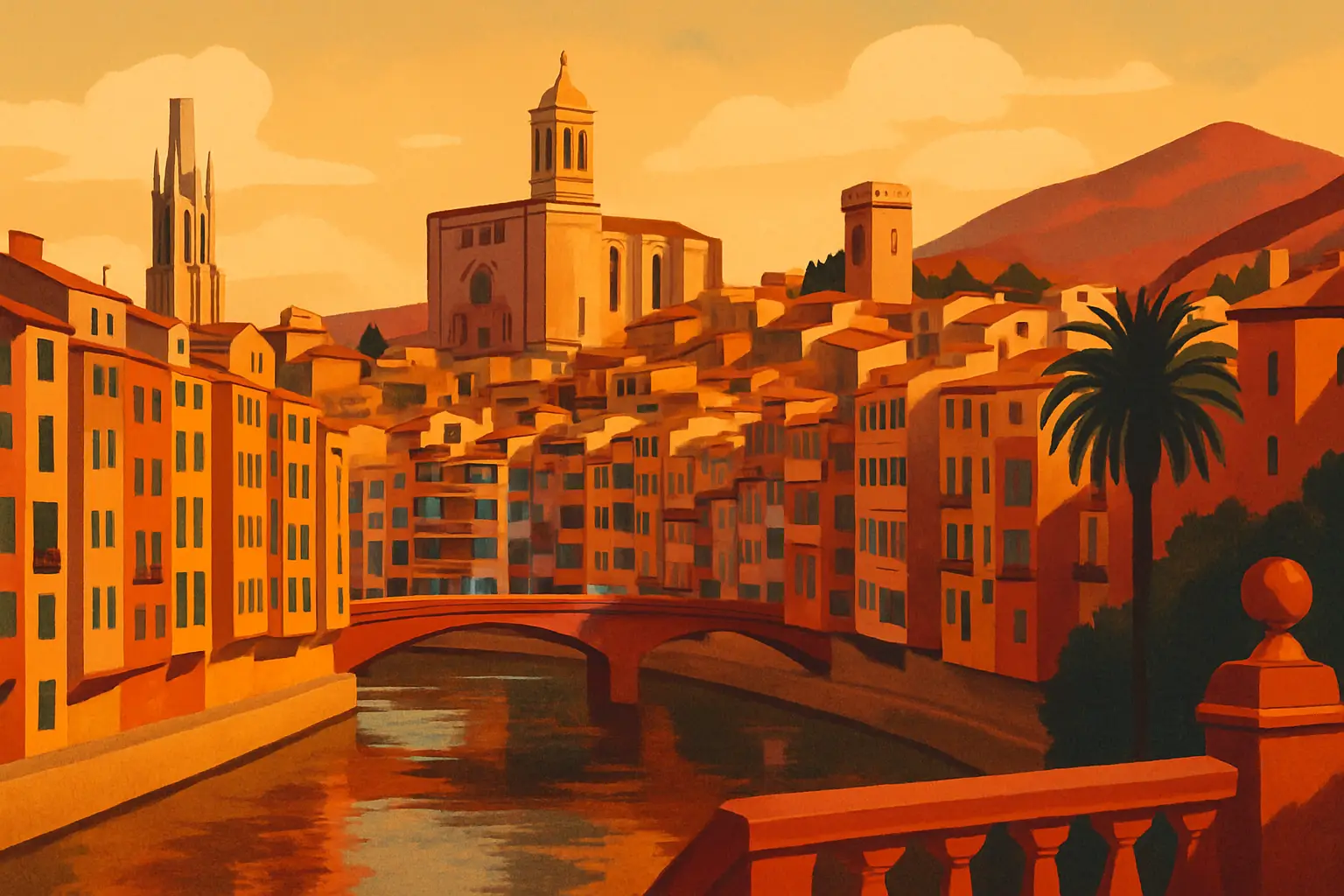
The image most associated with Girona is the row of tall, narrow, brightly colored houses lining the west bank of the Onyar River, their foundations built directly into the riverbank. The colors are not standardized: facades range from ochre to terracotta to pale yellow to light blue, each building painted independently over generations. The accumulated effect reads more like a coastal fishing village than an inland Catalan city, which is part of why photographs of Girona consistently surprise people who have never been.
The best view is from the Pont de les Peixateries Velles — the iron footbridge on Carrer de la Rambla designed by Gustave Eiffel's company in 1877, one of several iron bridge projects the firm built across Spain and Portugal in this period. It provides the straight-on view of the houses that defines Girona in travel photography.
Walking along the eastern bank on the Rambla de la Llibertat — Girona's equivalent of a promenade, lined with café terraces — connects directly to the Mercat del Lleó (Plaça Calvet i Rubalcaba), an early-20th-century iron-and-glass market hall open Tuesday through Saturday, 8 a.m. to 2 p.m. It is the most reliable place in Girona to find local cheese, charcuterie, and seasonal produce — and the least performatively touristic food experience in the city.
During Season 6 of Game of Thrones (filmed in 2015, broadcast 2016), Girona served as Braavos — the free city of canals and cobblestones where Arya Stark's storyline played out — and the production used specific real locations so precisely that a walking route through the old city following Arya's scenes is entirely coherent.
Placa dels Jurats, a small square immediately beside the Arab Baths, is where Arya watches the theatrical troupe perform the history of her family (including Ned Stark's death). In daily life it is a quiet residential square that most visitors walk past without recognizing it.
The Arab Baths (Banys Arabs, on Carrer Ferran el Catolic) served as the entrance to the Braavos market in the episode where the Waif pursues Arya through the crowd. The baths are also worth visiting independently: built in the 12th century in the Romanesque style but following the Arabic hammam layout, with the original changing room, cold pool, warm room, and hot room all intact, illuminated through an oculus above the central pool. Entry is €3.50.
The Monastery of Sant Pere de Galligants (Placa de Santa Llucia) served as the exterior of the House of Black and White. In reality it is a functioning archaeological museum (Museu d'Arqueologia de Catalunya - Girona) with one of Catalonia's best-preserved Romanesque cloisters and a solid collection of Roman-era finds from the Empuries excavations on the coast. Entry is €6.
A practical note: summer weekend crowds peak at the Braavos locations between 11 a.m. and 3 p.m. Go early morning and you will often have Placa dels Jurats entirely to yourself.
El Celler de Can Roca (Carrer Can Sunyer, 48) has been twice ranked the best restaurant in the world by the World's 50 Best (2013 and 2015), holds three Michelin stars, and in 2026 marks its 40th anniversary. The three Roca brothers — Joan (savory), Josep (sommelier), and Jordi (desserts) — run it as a family operation that has grown from a neighborhood bistro into something genuinely singular in European gastronomy without losing its local roots. Reservations open 11 months in advance and are exhausted within hours; build your calendar reminder now.
Rocambolesc (Carrer de Santa Clara, 50) is Jordi Roca's ice cream parlor — sculptural gelato and composed desserts at €4–€8. It is not a consolation prize; it is a genuine expression of the same creative approach applied to a format accessible without a reservation.
Mimolet (Carrer del Pou Rodo, 12) is the choice for a serious Catalan meal without the Can Roca booking obstacle. Set inside the Barri Vell, it focuses on seasonal Catalan produce — wild mushrooms in autumn, white asparagus in spring, local lamb year-round — with a wine list that leans toward natural and minimal-intervention Catalan producers. Mains €18–€28.
El Bistrot (Rambla de la Llibertat, 4) occupies one of the ground-floor spaces in the Onyar house row, with a terrace overlooking the river. The cooking is straightforward Catalan brasserie — good pa amb tomaquet, local cheese, and daily fish from the Roses fishing port 40 km north on the Costa Brava. Budget €20–€30 for a full meal.
For coffee and pastry: Forn Pastisseria Canal (Carrer de la Forca, 12, inside El Call) is a traditional Catalan bakery producing coca (a flat pastry with pine nuts and sugar) and croissants among the best in the city.
How long: Two nights minimum. One full day covers the Cathedral, El Call, the Arab Baths, and the Onyar houses at an unhurried pace. A second day allows for the medieval walls circuit (45 minutes, free), the Sant Pere de Galligants monastery, the Mercat del Llleo, and a proper evening in the Barri Vell. Three nights lets you add a half-day trip to Figueres (45 minutes by train, home to the Salvador Dali Theatre-Museum, the most-visited museum in Spain after the Prado) without feeling rushed.
When to go: Late April through June and September through October are ideal — temperatures of 18–26°C, manageable crowds, and everything open. July and August are hot (regularly 28–33°C in the old city), busiest on weekends when Barcelona day-trippers arrive in volume, and expensive for accommodation. November through March is quiet, cool, and perfectly functional — the Barri Vell is atmospheric without tourists, and prices for accommodation drop 30–40% from summer rates.
Getting there: From Barcelona Sants, AVE trains take 38–40 minutes (€12–€22, book ahead online). Regional R11 trains take about 80 minutes and cost €8 with no advance booking required. By car from Barcelona it is 100 km on the AP-7 motorway (about 1 hour); parking inside the old city is limited and expensive — use the Devesa park-and-walk area beside the river or the underground parking on Placa Catalunya.
Getting around: Girona's old city is entirely walkable. The entire Barri Vell covers about 700 meters north to south and 400 meters east to west. No taxis or buses are needed within the historic center — in fact, most streets inside the walls are inaccessible to vehicles.