The story behind El Escorial begins not with ambition but with a battle and a vow.
On August 10, 1557 — the feast day of San Lorenzo — Spanish forces under the Duke of Alba defeated a French army at the Battle of Saint-Quentin in what is now Belgium. Philip II, then ruling from Brussels, attributed the victory to the saint's intercession and vowed to build a church and monastery in Lorenzo's honor. The location he chose, after surveying the Sierra de Guadarrama foothills with his architects, was a granite outcrop above the village of El Escorial — remote enough to ensure privacy, close enough to Madrid (established as the Spanish capital in 1561) to function as a secondary royal court.
The building was not designed merely as a church. Philip's written instructions to his first architect, Juan Bautista de Toledo (a veteran of Michelangelo's workshop at St. Peter's Basilica), outlined four simultaneous purposes: a royal palace, a Hieronymite monastery (home to the Order of Saint Jerome, whose members would pray continuously for the souls of Spain's royal dead), a royal mausoleum for Philip's parents Charles I and Isabella of Portugal, and a college and library to anchor Spanish Catholic intellectual life. No building of comparable programmatic ambition had been attempted in Europe since the Vatican complex itself.
Construction began in April 1563. Juan Bautista de Toledo died in 1567, four years in, before the walls had risen past the first story. His successor, Juan de Herrera, completed the project in 1584 — 21 years after groundbreaking, a pace Philip monitored obsessively from a window in his private apartment that looked directly down onto the construction site. Philip II died in 1598 in the monastery he had built, in a small bedroom adjoining the basilica where he could hear Mass without leaving his bed during his final illness.
El Escorial established a new architectural vocabulary that would define Spanish royal building for the next century. The style is called Herreriano — Herreran — after Juan de Herrera, and its defining characteristics are the opposite of the ornate Plateresque and Baroque styles that dominated Spanish architecture before and after it.
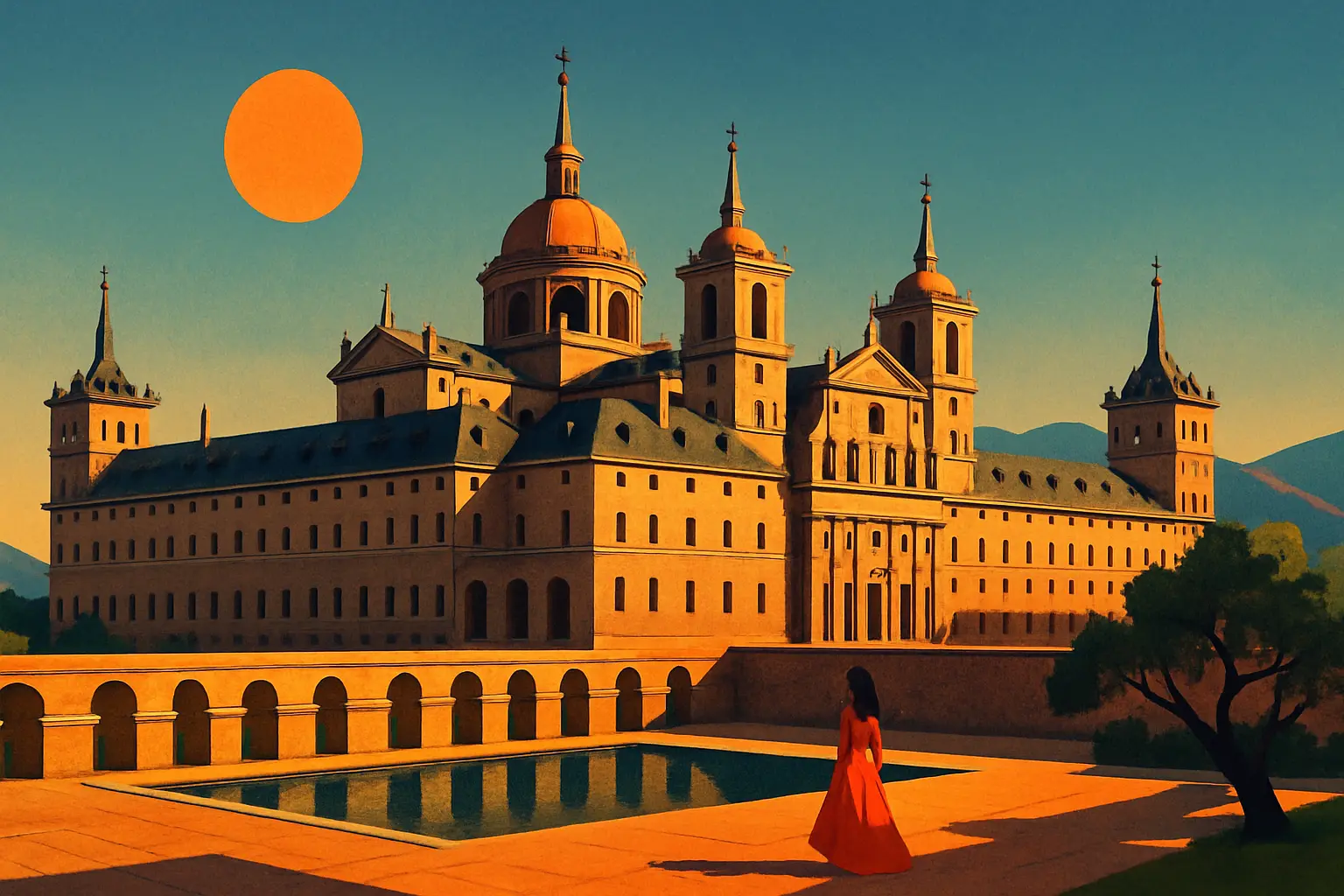
The exterior is almost entirely undecorated grey granite from the nearby quarries of Zarzalejo — no carved doorways, no sculptural programs on the facades, no color. The building's power comes instead from its scale (208 meters × 162 meters in plan), the precision of its masonry joints, and the rhythmic repetition of its 1,200 windows and 16 courtyards. Four square corner towers anchor the mass, a compositional move that Herrera borrowed from Italian Renaissance theory but executed with Spanish granite gravity.
The effect inside the Patio de los Reyes (Courtyard of the Kings), the main entrance forecourt, is the first real confrontation with the building's logic. Six bronze-gilt figures of the kings of Judah — David, Solomon, Jehoshaphat, Hezekiah, Josiah, and Manasseh — stand above the basilica portal. They were cast by the Flemish sculptor Pompeo Leoni between 1580 and 1584 and represent the biblical royal lineage that Spanish monarchy saw itself as continuing. Looking at them from the courtyard, with the granite grid of the monastery extending left and right and the Guadarrama peaks rising behind, it is possible to feel, briefly, what a 16th-century Spanish subject might have felt: that this building was not built by men alone.
The building contains **2,673 rooms**, **86 staircases**, **1,200 doors**, **1,250 windows**, and **73 statues**
Herrera also designed the **Palacio Real de Aranjuez** and influenced the design of the **Plaza Mayor** in Madrid
The granite came from quarries at Zarzalejo, 18km away — transported by ox-cart along roads built specifically for the construction
Get short, interactive stories that make each place easier to remember while you travel.
Philip II was a serious reader and an obsessive collector of manuscripts. The Real Biblioteca de El Escorial was designed from the building's inception as one of the great European repositories of knowledge — a counterpart to the Vatican Library, consciously positioned as the intellectual center of Catholic Europe.
The library occupies the entire upper floor of the main western entrance block, a single galley 54 meters long and 9 meters wide. The ceiling is covered in frescoes by Pellegrino Tibaldi (completed 1592), a Milanese painter working in the Mannerist tradition, depicting the seven liberal arts — Grammar, Rhetoric, Dialectic, Arithmetic, Music, Geometry, and Astronomy — as monumental female figures with supporting narrative scenes. The frescoes are among the finest examples of Italian Mannerism outside Italy.
The shelves themselves are the room's architectural event. Juan de Herrera designed them as built-in walnut cases running the full length of both side walls, floor to ceiling, with a distinctive feature that strikes every visitor: the books are shelved spine inward, fore-edge outward. This was not arbitrary. Philip II's librarian, Benito Arias Montano, ordered the practice specifically to protect the gilded and painted covers of illuminated manuscripts from ultraviolet light. The gold-and-silver decorated fore-edges visible from the aisle create a visual texture unlike any other library interior in the world.
The collection at Philip II's death included 4,700 manuscripts (including Arabic, Hebrew, Greek, and Latin texts acquired from across the Spanish empire), plus early printed books from across Europe. A fire in 1671 destroyed roughly a third of the printed collection; the surviving manuscripts were spared. Today the library holds approximately 40,000 printed volumes, 2,700 manuscripts, and 5,000 drawings — including some of the earliest known maps of the Americas and original Arabic scientific treatises acquired during the conquest of Granada in 1492.
The 16th-century **Arabic manuscripts** — over 1,800 volumes — were acquired after the fall of Granada and represent one of the largest collections of Islamic texts in a European royal library
Access to the library was restricted from its founding: Philip II required written permission for any scholar to consult manuscripts, a rule that remained in force in some form until the 20th century
One of the library's most prized objects is the **Book of Hours of Philip II** — an illuminated Flemish manuscript that Philip carried with him throughout his reign and which is displayed in rotation in the main hall
Beneath the high altar of the basilica, accessed by a staircase of black marble and gilded bronze, is the Panteón de Reyes — the Royal Pantheon of the Kings of Spain. It is one of the most extraordinary rooms in Europe and one of the least remarked upon in standard travel accounts.
The chamber is circular, approximately 16 meters in diameter, with walls entirely faced in dark marble (grey from Genoa, black from Flanders, red from Toledo) and gilded bronze detailing. Twenty-six stone sarcophagi are arranged in tiers around the circular wall, each sealed with bronze plaques bearing the names and dates of the monarchs interred within. The room holds the remains of nearly every Spanish king and queen-consort since Charles I (Holy Roman Emperor Charles V), who died in 1558. Philip II himself is in the lowest-right tier, closest to the altar above.
Two specific details are worth knowing before you enter. First, the sarcophagi facing the altar (the left side as you enter) hold kings; those on the right hold queen-consorts. Queen-regnants — women who ruled in their own right — are buried separately in the adjacent Panteón de los Infantes (Pantheon of the Infants), which is considerably larger and less visited. The Infants' pantheon holds 60 burial niches spread across nine rooms and includes the remains of children of the royal family, some of them in memorably small white marble sarcophagi that stop visitors in their tracks.
Second, the pudridero — a waiting chamber below the Pantheon, not accessible to visitors — is where royal remains are placed for a period of 25–30 years before transfer to the sarcophagi, to allow complete decomposition. In 2019, the exhumed remains of Francisco Franco were interred in the pudridero at Mingorrubio, outside Madrid, after his removal from the Valle de los Caídos — a reminder that Spanish royal mortuary politics remain active centuries after Philip II laid out the original protocol.
The Basilica of San Lorenzo at El Escorial is not the largest church in Spain, but its interior proportions create an effect of vertical scale that the square footage alone does not explain. The nave is 92 meters long and the vault rises 34 meters — numbers made concrete by the fact that the church can hold 1,600 people and frequently did, when Philip II required the entire monastic community and royal household to attend Mass simultaneously.
Behind the main altar, in a niche to the right of the high altarpiece, stands the Cristo de El Escorial — a marble crucifix carved by Benvenuto Cellini in the 1550s and acquired by Philip II from the Medici collection. Cellini described it in his autobiography as his greatest work, carved from a single block of white Carrara marble, and subsequent centuries of scholarly opinion have not disagreed significantly. The figure — slightly larger than life size, anatomically precise, with the head tilted to the left and the hands modeled with individualized fingers — was carved, according to Cellini, after a wax model that he made using an actual human skeleton as reference. It has remained in the niche at El Escorial since 1576.
The royal apartments in the northeast corner of the building preserve Philip II's working and private spaces. The king's study retains his chair (modified with a rest for his severely gout-afflicted leg), his writing desk, and the small window that looked directly onto the basilica altar — his sickbed in the final months of his life was positioned so that he could see the high altar from his bed. The rooms are modest in decoration by European royal standards, which is the point: Philip's self-presentation was deliberately austere, a theological statement as much as a personal preference.
The **high altarpiece** is one of the largest altarpieces in the world, designed by Herrera and gilded in 1586; the paintings in the niches are by Federico Zuccaro and Bartolomé Carducho
Philip II's original portrait by Sofonisba Anguissola (one of the first major female painters of the Renaissance) hung in the royal apartments during his lifetime; copies remain in the palace
The monastery remains an active Augustinian community — the Hieronymite order was expelled in 1835 during the suppression of the monasteries; the Augustinians arrived in 1885
The town of San Lorenzo de El Escorial that grew up around the monastery is worth an hour of your afternoon. The main street, Calle Floridablanca, is lined with outdoor restaurants and bars that draw Madrileños on summer weekends; by September, the tourist restaurants are thinner and the neighborhood spots more visible. The Café Zaguán (Calle Leandro Rubio 2) has been operating in the same building since the 19th century and serves a reliable lunch menu.
The Casita del Príncipe (also called the Casita de Abajo) is a small neoclassical pavilion built by Juan de Villanueva in 1772 for the future Carlos IV, set in jardines that open to the public on Wednesdays and Saturdays. Entry to the casita itself is included in the main monastery ticket; the gardens are free. In late September and October, the surrounding chestnut and oak forest in the Parque Natural de la Cumbre, Circo y Lagunas de Peñalara begins to turn, making the walk from the casita along the Calle de la Herrería one of the better autumn color walks accessible by public transport from Madrid.
The Valle de los Caídos — now officially renamed Valle de Cuelgamuros — is 9km from El Escorial. The site, built between 1940 and 1959 using Republican prisoner labor under Franco's orders, contains a basilica carved directly into granite rock and a 150-meter cross visible from kilometers away. Francisco Franco's remains were exhumed from the site in October 2019 by court order and reinterred at Mingorrubio cemetery outside Madrid. The monument is now managed as a historical memory site. It is accessible by car or taxi from El Escorial; there is no direct public transport connection. Whether to visit is a question that Spanish public debate has not fully resolved — the site's context and significance are complex enough that it warrants preparation before arrival rather than a casual stop.
By bus (recommended): The Herranz company operates lines 661 and 664 from Madrid Moncloa intercambiador (bus station, not just the metro stop). Line 661 runs via Galapagar and takes approximately 65 minutes; line 664 runs via Guadarrama and takes approximately 55 minutes. Buses run every 15–30 minutes on weekdays, less frequently on Sundays. The fare is approximately €4.60 each way. The stop in El Escorial is directly in front of the monastery's main entrance on Calle Juan de Borbón y Battemberg — no connecting transport needed. Buy tickets on the bus.
By train (Cercanías): Renfe Cercanías line C-8a runs from Madrid Atocha and Chamartín to El Escorial station in approximately 60 minutes. Trains run roughly every 30 minutes during peak hours. Fare is €5.90 with a ten-trip ticket (Abono) or around €7 for a single journey. The train station is at Calle Ferrocarril, 4km from the monastery in the lower part of town — take local bus L-1 from outside the station (frequent, around €1.40) or a taxi (approximately €6, 7 minutes).
By car: From Madrid, take the A-6 motorway (Autopista del Noroeste) to exit 47 for M-600, then follow signs to San Lorenzo de El Escorial. Journey time is 45–60 minutes from central Madrid depending on traffic. Paid parking is available in several lots near the monastery; the Aparcamiento del Monasterio on Calle Grimaldi has the highest capacity. In September, parking is easy to find before 11am; arrival by 10am is recommended to avoid any queue at the entrance.
**Bus from Moncloa**: best option for most visitors — direct, cheap, frequent. Journey ~55–65 minutes
**Train from Atocha/Chamartín**: comfortable if you prefer rail; budget extra 15 minutes for the local bus or taxi connection from El Escorial station
**Combined ticket (Abono + local bus)**: Madrid's Abono Transportes (monthly pass) covers the Cercanías C-8a journey if you're in zone B1 or wider; check your zone before buying a separate ticket
**Return buses from El Escorial to Moncloa** run until approximately 11pm on weekdays and 10pm on Sundays — no need to rush your afternoon
When is the best time to visit El Escorial? September and October are, by a significant margin, the best months. August brings school-holiday crowds from both Madrid and European tour groups; the monastery can feel overwhelmed in high summer, and the interior rooms — particularly the Pantheon stairs — become uncomfortably warm. By the second week of September, visitor numbers drop sharply, the surrounding mountains begin their color shift, and the monastery can be experienced more or less at pace. Spring (April and May) is the second-best window, with fewer visitors than summer and the monastery gardens at their best.
How long does a visit take? Allow a minimum of 3 hours for the monastery itself if you want to see the library, the royal apartments, the pantheons, and the basilica properly. With lunch in the town and a walk in the Casita del Príncipe gardens, a full day is easily filled. Most visitors from Madrid make the trip as a day trip and return on an evening bus.
Is El Escorial suitable for children? Genuinely yes, more than most history-heavy sites. The building's scale impresses children viscerally — the Pantheon of Kings' circular room in particular tends to generate immediate reactions. The marble sarcophagi are tangible and non-abstract in a way that makes the concept of historical mortality legible for children older than about 8. The surrounding gardens and the forest between the monastery and the town give children room to decompress between interior visits.
Can I combine El Escorial with Toledo or Segovia in one day? Not comfortably. All three require roughly 3–4 hours of dedicated visiting plus travel time from Madrid. El Escorial pairs naturally with a morning visit to the Valle de los Caídos/Cuelgamuros (9km away by taxi) or an afternoon in the town and gardens. Pairing it with Segovia means an overnight stay, or a very rushed version of both — pick one per trip.
**Opening hours**: Tuesday–Sunday 10am–6pm (April–September); 10am–5pm (October–March). Closed Mondays and certain public holidays
**Ticket prices (2026 approximate)**: General admission €12; reduced (students, over-65) €6; free for EU citizens under 25 and Erasmus students with ID
**Audio guide**: Available for rent at €4 inside the entrance; highly recommended for the Royal Library and Pantheon rooms specifically
**On-site dining**: The monastery's cafeteria (inside the complex) serves sandwiches and coffee at modest prices; the town's restaurants are a 10-minute walk and considerably better for a sit-down lunch