1. The Manchester of the Mediterranean
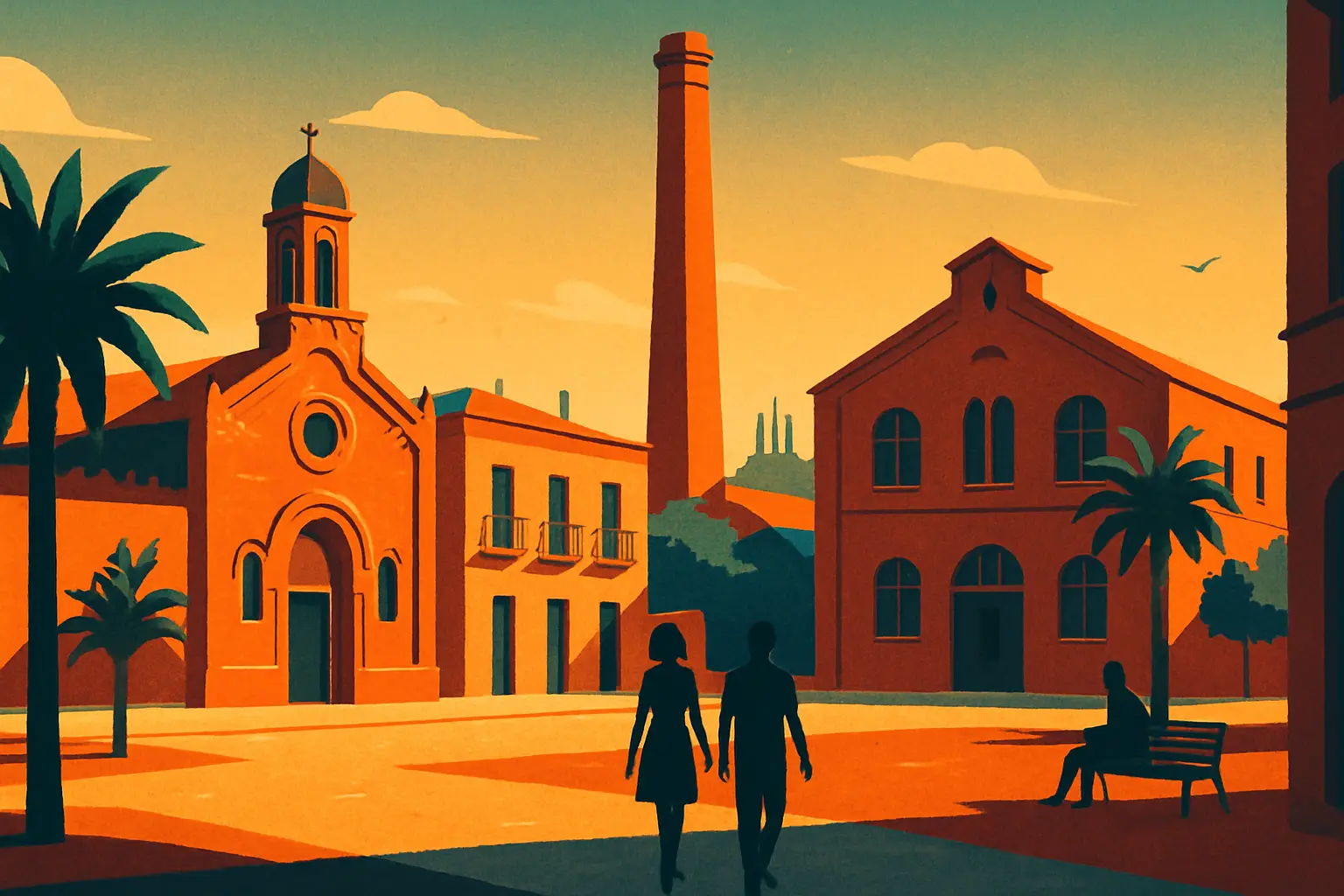
The name Poblenou — Catalan for 'new village' — is at least 600 years old, referring to a modest settlement that grew outside Barcelona's medieval walls where the city's workers and artisans lived beyond the reach of urban taxation. That quiet origin does not prepare you for what the neighborhood became.
By 1850, Poblenou had 117 factories operating within its boundaries. The steam engine arrived in Barcelona here first, imported from England by the textile industry. Foundries, printing presses, chemical works, and cotton mills made the district a continuous plume of smoke along the coast northeast of the old city — enough to earn it the nickname 'Manchester of the Mediterranean', coined by English visitors who saw the resemblance to what that city had been 30 years earlier.
The industrial concentration lasted roughly a century. Global competition, labor unrest, and the slow shift of manufacturing away from city centers eroded the base through the 20th century. By the 1980s, large sections of Poblenou were a landscape of shuttered factories, weedy lots, and declining population — the cost of having been too useful too early. The neighborhood that exists today was rebuilt from that starting point over the last 35 years, and its industrial past is still visible in every second building facade.
2. The 1992 Olympics and the opening of the waterfront
Before 1992, Poblenou's coastline was inaccessible. A wall of industrial installations, railway lines, warehouses, and contaminated beach blocked residents from the sea along nearly the entire length of the neighborhood. Barcelona's bid for the 1992 Summer Olympics was partly a bid for the infrastructure budget to tear that barrier down.
The transformation was the most significant urban intervention in Barcelona since Ildefons Cerda's Eixample expansion plan of 1859. The city demolished the industrial coastal edge, extended the Passeig Maritim north through former factory land, and built the Vila Olimpica — the Athletes' Village — on the southern fringe of Poblenou. That village, which housed 15,000 athletes during the Games, became a residential neighborhood of roughly 8,000 apartments the moment the closing ceremony ended.
Two towers define the skyline where the Vila Olimpica meets the sea: the Hotel Arts and the Torre Mapfre, both 154 meters tall, both completed in 1992 for the Games. Standing on the beach at the Port Olimpic marina and looking north along the coast toward Mar Bella, you are looking at waterfront that did not exist before the Olympic project. Barcelona residents who grew up in Poblenou in the 1970s describe the opening of the sea as genuinely transformative — an amenity they had always lived beside but could not reach.
3. The 22@ district: 200 hectares of factories turned tech campus
In 2000, Barcelona City Council launched Plan 22@ — one of the most ambitious urban tech district projects in Europe at the time. The name comes from zoning: Poblenou's industrial land was classified '22a' under the city's urban code. The @ was a deliberate signal about what was meant to replace it.
The plan converted 200 hectares of former industrial land into a mixed-use zone allowing technology companies, design studios, universities, and residential development to coexist on the same blocks where textile mills had stood a century earlier. A requirement that new developments retain proportional elements of the industrial architecture — facade materials, building heights — explains why the 22@ district looks unlike any other European tech campus: glass office blocks set behind preserved brick facades, co-working spaces in what used to be machine halls.
Torre Glories at the Avinguda Diagonal end of the district is its most visible landmark: a 144-meter conical glass tower designed by Jean Nouvel, covered in aluminium and glass panels that can display 16 million color combinations through an LED lighting system visible across the city each night. Originally commissioned as the headquarters of Agbar (the Barcelona water company) and still widely called Torre Agbar despite a later renaming, it anchors the Placa de les Glories Catalanes end of the neighborhood. Directly beside it, the Disseny Hub Barcelona — the city's Design Museum — opened in 2014 with collections spanning product design, fashion, graphic design, and decorative arts from the 15th century onward.
4. Rambla del Poblenou, the street art circuit, and the Palo Alto Market
The Rambla del Poblenou runs 1.5 kilometers from the Placa de les Glories roundabout south to the beach at Placa del Doctor Trueta. It is a pedestrian boulevard lined with plane trees — wider than most Barcelona streets and slow enough to walk without purpose. Unlike Las Ramblas, it does not exist primarily for tourists. The people sitting at outdoor tables here at noon on a Tuesday are the people who live here. El Tio Che at No. 44 has been operating since 1912, making it the oldest surviving cafe in the neighborhood. Order the horchata.
Two blocks east of the Rambla, the block bounded by Carrer de Pallars, Carrer de Roc Boronat, and Carrer de Sancho de Avila is Poblenou's most concentrated street art circuit — murals painted directly on former factory walls, with works by artists from across Europe and South America. The scale distinguishes it from most street art locations: factory walls run 10–15 meters high, and the murals are proportionally large.
On the first weekend of each month, the Palo Alto Market fills the courtyard of a converted factory complex at Carrer dels Pallars, 30 with approximately 70 design and artisan vendors. It is the best Sunday market in Barcelona for objects worth bringing home — ceramics, textiles, illustration prints, sustainable clothing — and less crowded than its reputation suggests because it does not appear on standard tourist itineraries.
5. Can Framis Museum and the cemetery of the industrial bourgeoisie
Can Framis at Carrer de Roc Boronat, 116-126 is the oldest standing building in Poblenou: a wool-washing factory dating from the late 16th century, preserved inside what would otherwise be a block of new residential development. It is one of the few remaining pieces of pre-industrial architecture in a neighborhood defined by what replaced it.
Since 2009, Can Framis has housed the Museu Can Framis — the Fundacio Vila Casas collection of contemporary Catalan painting from the 1960s to the present. About 300 works are displayed in the stone rooms of the original factory building, creating a productive tension between the medieval structure and the abstract and figurative canvases inside. Admission is €6; free on Sundays.
A 10-minute walk north along Carrer de Pallars brings you to the Cementiri de Poblenou — also called the Cementiri de l'Est — opened in 1775 and one of the most architecturally elaborate cemeteries in Catalonia. The families who made their money in Poblenou's 19th-century industries commissioned mausoleums here on a competitive scale: neo-Gothic chapels, marble statues, and wrought iron gates that turned the cemetery into a permanent exhibition of industrial-era wealth. The most specific thing worth finding is a marble sculpture near the central avenue — a skeletal figure leaning forward to kiss a young man — commissioned by the Llaudet family around 1930 and called El peto de la mort: 'The Kiss of Death.' Entry is free during opening hours (generally 8 a.m. to 6 p.m.).
6. The beaches: Mar Bella and Bogatell
Poblenou's coastline includes the two least crowded sandy beaches within the city of Barcelona. Neither is obscure; both are simply further from the Gothic Quarter than most visitors are willing to walk or metro.
Platja de la Mar Bella is the first beach north of the Port Olimpic. It has a dedicated sports area with gym equipment and volleyball courts, a dog beach section at the northern end, and a clearly marked naturist zone in the center. In August, water temperature along this stretch of coast reaches 26–27°C. The nearest chiringuito (beach bar) is a branch of Barceloneta's Xiringuito Escriba, serving serious seafood at serious prices — worth a reservation in summer.
Platja de Bogatell, the next beach north, is slightly longer and better equipped with shade structures. It is popular with volleyball players and families with young children. The metro stop for both beaches is Selva de Mar on Line 4 (yellow), a 7-minute walk inland.
7. Where to eat and drink in Poblenou
Poblenou's food scene reflects its demographic mix: working-class neighborhood institutions that predate the 22@ transformation, and newer places that serve the creative industries that arrived after 2000.
•**El Tio Che** — Rambla del Poblenou, 44. The oldest cafe in the neighborhood (1912). Horchata de xufa, granizados, and orxata served from a street booth. Around €2 a glass. Seasonal hours vary — typically 9 a.m. to 9 p.m. in summer.
•**Xiringuito Escriba** — Litoral Mar, 42. Seasonal beach restaurant (open April through September) serving some of the best paella in Barcelona, plus seafood rice dishes and grilled fish. Reserve ahead in August — the terrace fills by noon.
•**Balius Bar** — Carrer del Pallars, 196. A bar in a converted factory unit with natural wines, creative small plates, and craft beer. Popular with 22@ workers from 7 p.m. onward.
•**La Pepita** — Rambla del Poblenou, 15. A brunch cafe with good coffee and eggs done well — unusual for Barcelona. Usually quiet on weekday mornings; fills on weekend brunch service.
•**Napoli** — Rambla del Poblenou. A classic neighborhood taverna operating since the 1930s, with a tiled interior, Estrella Damm on draft, and a rotating menu of simple Catalan dishes. No website, no reservations — just a door that opens at noon.
8. Practical guide: getting there, how long, and what to know
Poblenou is easy to navigate and compact enough that most things are within a 20-minute walk of each other.
•**Getting there:** Metro Line L4 (yellow) to Poblenou or Selva de Mar stations. Line L10 (light blue) serves the 22@ area with stops at Llacuna and Bac de Roda. The neighborhood is also reachable by bike along the Passeig Maritim from [Barceloneta](/es/blog/barceloneta-barcelona-neighborhood-guide) in about 20 minutes on flat ground.
•**How long to spend:** Half a day covers the 22@ area, the Rambla, and the street art circuit. A full day allows time at the beach, a visit to Can Framis Museum, the cemetery, and a meal.
•**Is Poblenou touristy?** Not particularly. The neighborhood appears on tourist radars but does not have the density of visitors that [El Born](/es/blog/barcelona-el-born-neighborhood-guide) or the Gothic Quarter do. You are much more likely to be surrounded by local residents than tour groups.
•**August food note:** Some Poblenou restaurants close for summer vacation in August — the same pattern common across Spanish cities. Check for closure notices before building your itinerary around a specific place.
•**Best overall months:** April–May and September–October for mild weather and a full open neighborhood. August is perfectly fine — the beaches are at their best, and the 22@ area quiets down as companies send staff on summer break, making the architecture easier to appreciate without weekday crowds.