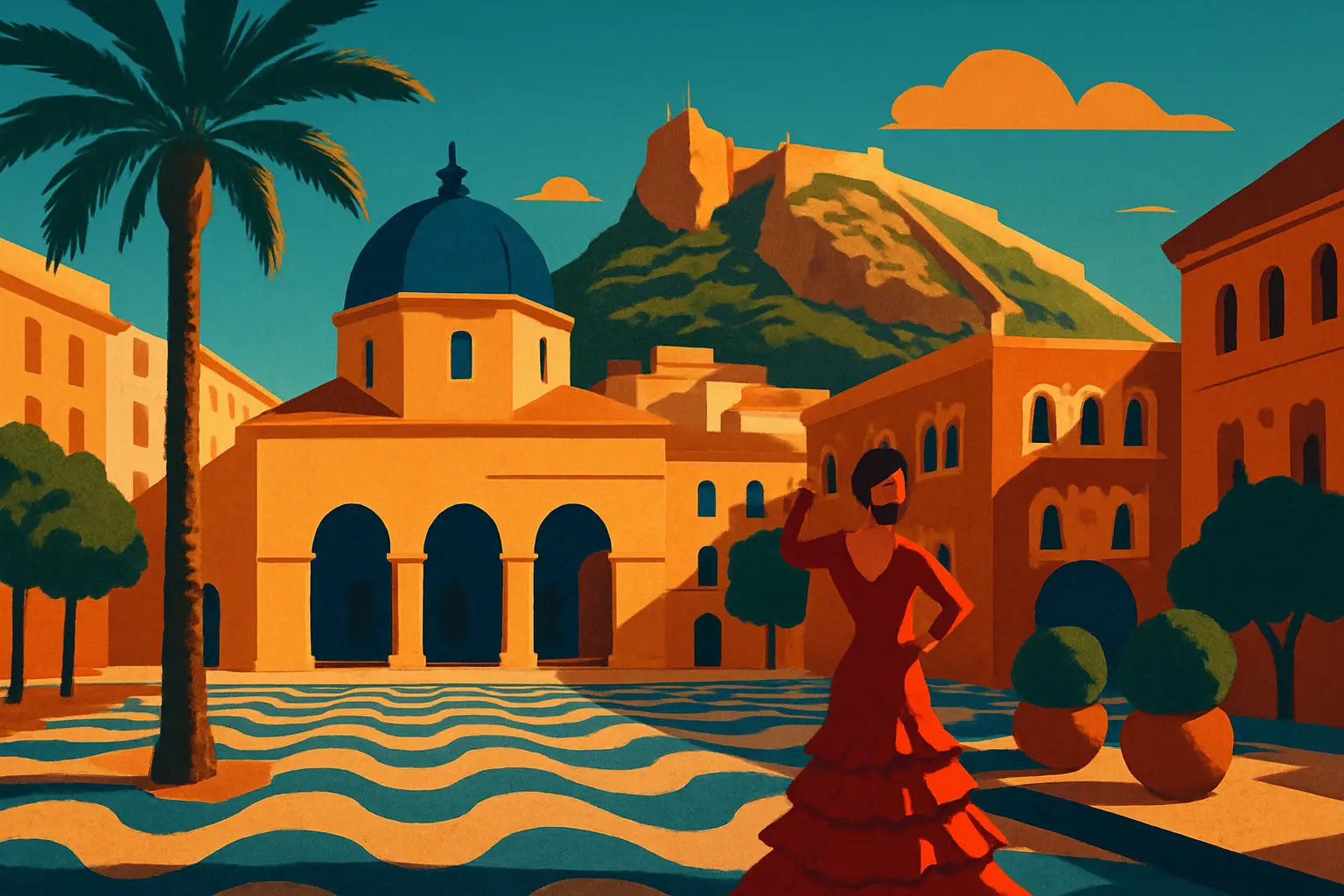
The site of Alicante has been inhabited since the Bronze Age, recognized by every Mediterranean civilization that encountered it as an ideal harbor behind a limestone hill that could be fortified. Iberians knew it; Romans formalized it as a provincial port; Moors rebuilt it from the 8th century onward under the name Al-Laqant, from which the modern name descends. The hill never stopped being the strategic core of the settlement.
Today Alicante-Elche Airport (ALC) is the third-busiest in Spain by passenger numbers, receiving direct flights from more than 50 countries. Almost all of those passengers are heading somewhere else. The city's permanent population is 340,000, with an economy built on the port, tourism, and the surrounding province's orange groves and wine production. It is coastal Spain without the resort-strip monotony of parts of the Costa del Sol, and without the heritage-tour pressure of Seville or Córdoba. A city that functions first for its residents — which is, along the Spanish Mediterranean coast, increasingly unusual.
The castle occupies the summit of El Benacantil — a bare limestone ridge rising 166 meters directly behind Postiguet Beach, visible from the entire city and the harbor. Moorish fortifications stood here from at least the 9th century. Alfonso X of Castile captured the stronghold on December 4, 1248 — the feast day of Saint Barbara, martyr and patron of artillery — and the name has held across seven and a half centuries.
The structure was comprehensively rebuilt in the 16th century by Habsburg military engineers, who added a system of artillery bastions, gunpowder magazines, and cascading defensive walls designed for the cannon era. During the Spanish Civil War the castle functioned as a political prison. The complex today spans three connected levels: the lower castle (accessible from the beach lift), the middle castle with the main defensive towers, and the upper castle at the summit — 360-degree views over the city, the bay, and on a clear day to the island of Tabarca 20 kilometers south.
Admission is free; the lift through the cliff from Postiguet Beach costs approximately €2.70 round trip. Open 10:00 AM–10:00 PM in high summer. The hiking path up from El Barrio via Calle Benacantil takes 20–25 minutes and is the better option for the descent, dropping you directly into the old town rather than back to the beach.
Admission: free. Lift: €2.70 round trip from Postiguet Beach.
Hours: 10:00 AM–10:00 PM July–August; 10:00 AM–8:00 PM April–June and September–October.
Hiking route up: Calle San Francisco → El Barrio → Calle Benacantil → castle gate. 20–25 minutes. Better than the lift for anyone coming from the old town side.
Get short, interactive stories that make each place easier to remember while you travel.
Directly beneath the castle's lower walls, El Barrio de Santa Cruz is Alicante's historic quarter — a neighborhood of steep narrow lanes, whitewashed houses, painted window frames, and flower-covered balconies that grow more elaborate the higher you climb. The streets follow pre-Christian and Moorish-era footpaths; many are too narrow for vehicles and some are built as stairways cut into the slope.
The neighborhood's anchor is the Basilica de Santa Maria at Plaza de Santa Maria — the oldest active church in Alicante, built between 1313 and 1512 on the site of the city's main Moorish mosque. The structure is Gothic; the main facade was rebuilt in Baroque style in the 17th century, with carved stone figures by Juan Bautista Borja that show evident Churrigueresque influence. The interior retains its original single-nave Gothic structure with a carved retablo (altarpiece) and side chapels. Admission is free; open Tuesday–Saturday 10:30 AM–1:00 PM and 5:30–7:30 PM.
Four blocks south, the Cathedral of San Nicolas de Bari — completed in 1662, also on a demolished mosque site — anchors the lower neighborhood at Plaza del Abad Penalva. Its blue-tiled dome is visible on the Alicante skyline from the sea. Both major churches built within four blocks of each other, both on razed mosques, both completed in the two generations after the Reconquista, make El Barrio a concentrated document of how the political transformation of Mediterranean cities expressed itself in brick and stone.
The Explanada de Espana is a 500-meter seafront promenade running along the harbor between the ferry terminal and the marina, shaded by tall date palms and bordered by outdoor terrace cafes. Its defining feature is the floor: 6.5 million marble tiles in red, cream, and black arranged in a continuous undulating wave pattern (an adaptation of the Valencian *trencadis* technique). The pattern was designed by architect Victor Navarro Pastor and installed between 1953 and 1954 — it remains the most-reproduced image of Alicante and has been recognized by the municipal government as a piece of civic heritage.
The promenade's utility follows the sun. In the morning it is a running and cycling route. Between noon and 6:00 PM in summer the marble surface stores and radiates heat at uncomfortable levels — it is, in peak August, essentially unwalkable in bare feet. From 8:00 PM onward it becomes the city's most important public space: a slow-moving evening crowd of locals and visitors, terrace cafes serving horchata and clara, couples on bench seats facing the harbor, and the low amber light catching the wave pattern at an angle that makes the floor appear to move.
At the southern end, the Puerto de Alicante passenger terminal offers high-season ferry connections to Ibiza (approximately 3 hours) and Mallorca — cheaper than flying when booked two or more weeks out.
Arroz a banda — 'rice apart' — is the defining dish of the Costa Blanca fishing coast, born in the communities around Alicante, Santa Pola, and Guardamar in the early 20th century. The structure is in the name: a rich broth is made from the parts of the morning's catch that didn't sell at market — heads, bones, small rockfish, shellfish shells — then strained. That same broth first poaches a selection of fish and shellfish, which is served *a banda* (apart, separately) as a first course. The broth then cooks the rice — with saffron, sofrito, and the concentrated seafood base already built in — as the main course.
The result is rice with a depth of flavor that fresh-fish paella, where raw ingredients cook alongside the rice in a single pan, cannot replicate in the same way. Alioli — the Valencian garlic emulsion, richer and closer to garlic mayonnaise than the Catalan version — is served separately and stirred into the rice at the table by the diner.
The broader rice repertoire of the Alicante coast extends to caldero (a thicker, spicier fish-and-rice preparation associated with the village of Santa Pola, served with the broth on the side), arroz con bogavante (rice with a split fresh lobster, the festive version), and arroz negro (squid-ink rice with cuttlefish and alioli). All trace to the same origin: generations of fishing communities turning catch that didn't sell into refined technique.
Every June 20–24, Alicante's neighborhoods spend months building hogueras — towering sculptural monuments of wood, cardboard, and papier-mache, satirical and comic, sometimes reaching four stories in height. Each one is judged by a panel of experts in the days before the festival. Then, at midnight on June 24 (La Nit de la Crema — the Night of the Burning), all 220+ hogueras across the city are set alight simultaneously. Within 20 minutes, everything built over those months is ash.
The festival is a direct sibling of Las Fallas in Valencia (March): the same artistic tradition, the same ritual destruction, the same daily mascletà (daytime percussion-and-fireworks performance) at noon in the main square — here, Plaza de los Luceros — and the same indultado, the one piece each year voted to be spared and placed in a museum. The difference is the calendar: Hogueras falls on the feast of Saint John the Baptist, the summer solstice, with bonfires as the central element rather than Valencia's more elaborate monuments.
The Concurso Internacional de Fuegos Artificiales (Fireworks Competition) immediately follows, June 24–29, with competing pyrotechnic teams from across Europe and Latin America launching from El Postiguet beach. It is widely considered one of the two most prestigious fireworks competitions in Spain, alongside the one in Valencia.
For visitors who cannot time a trip for June: the Museo de Fogueres de Sant Joan at Plaza del Mar displays rescued ninots, photographs, and a documentary on the festival's social and artistic structure. Open Tuesday–Saturday 10:00 AM–2:00 PM and 5:00–8:00 PM; free entry.
Isla de Nueva Tabarca is the only permanently inhabited island in the Valencia Community: 1.8 kilometers long, 400 meters wide, home to approximately 50 year-round residents and several thousand day-trippers in summer. The island takes its name from Tabarka, a Tunisian island where Spanish prisoners were held in the 18th century; upon their repatriation, Charles III settled them on this island and constructed a small walled town — complete with a church (dedicated to Saint Peter and Paul, 1770), a gate, and a grid of streets — which remains largely intact.
The waters around Tabarca are a marine reserve, designated in 1986, with some of the clearest visibility in the western Mediterranean. Posidonia seagrass meadows below the surface support a fish population that has recovered noticeably since the reserve was established — schools of bream, bass, and barracuda are visible snorkeling off the town walls in depths of two to four meters. The water temperature in August runs 26–27°C.
Boats depart from the Alicante port terminal (at the southern end of the Explanada) throughout the day in summer, roughly every two hours from 9:00 AM. The crossing is 45 minutes; return tickets run approximately €17–20. The last return in August is typically 7:00 PM — confirm at the terminal. There is one hotel on the island. Most visitors come for the day; bring water, since the island's single market closes early and prices for everything are tourist-level.
By air: Alicante-Elche Airport (ALC) connects to more than 50 countries on direct routes. TRAM Line 3 from the airport terminal reaches Luceros station in the city center in 30 minutes for €3.85. Taxis to the center run €18–25.
By train: There is no AVE high-speed connection from Madrid to Alicante — trains run via Valencia on the conventional network. A Renfe Alaris or Intercity service from Madrid Atocha takes 3 hours 30 minutes to 4 hours and costs €30–60. From Valencia, regional trains run every 30–60 minutes: 1 hour 45 minutes to 2 hours 30 minutes depending on service.
Best time to visit: July and August are peak season — beaches at their warmest (sea temperature 26–27°C), longest evenings, and the city at full energy, but accommodation prices at their highest and Postiguet Beach genuinely crowded by 11:00 AM. June is the best single month for combining good beach conditions with the Hogueras de San Juan festival (June 20–24) and the post-festival Fireworks Competition. May and October offer mild temperatures (20–25°C), uncrowded beaches, full restaurant hours, and accommodation at 30–40% below August rates.
Airport to center: TRAM Line 3 | €3.85 | 30 minutes | Every 20–30 minutes
Train from Madrid: Renfe Alaris via Valencia | 3h 30m–4h | €30–60 advance purchase | Alicante Terminal station
Train from Valencia: Renfe regional | 1h 45m–2h 30m | €7–15 | Several per hour in peak season
Best months: June (Hogueras + good sea temps), May and October (mild, uncrowded, lower prices)